If you have been playing for a few weeks, you have likely realized that the team controlling the net usually wins the point. But what do you do when your opponents throw up a deep lob, forcing you to retreat? Learning exactly how to hit a bandeja is the ultimate solution to this problem, and it is arguably the most important technical shot you can develop to elevate your game and maintain your offensive advantage.
Why Learning How to Hit a Bandeja is Crucial
For players transitioning from tennis, the natural instinct when seeing a high ball is to hit an aggressive, powerful smash to end the point immediately. However, in this sport, a hard smash from the back of the court will simply bounce high off the back glass, giving your opponents an easy counter-attack opportunity. The bandeja—which translates directly to “tray” in Spanish—is a defensive and tactical overhead shot designed specifically to keep the ball extremely low.
By using this shot, you buy yourself precious seconds to recover your position. You are not trying to hit an outright winner. Instead, you are hitting a controlled, slicing overhead that forces the ball to stay incredibly low after it bounces on your opponents’ side of the court. By mastering this, you prevent them from attacking, allowing you and your partner to safely sprint back to your commanding position at the net.
Step-by-Step Guide: How to Hit a Bandeja
Mastering this stroke requires breaking it down into distinct phases. Here is the exact progression you need to follow.
1. Early Racket Preparation and the “Tray”
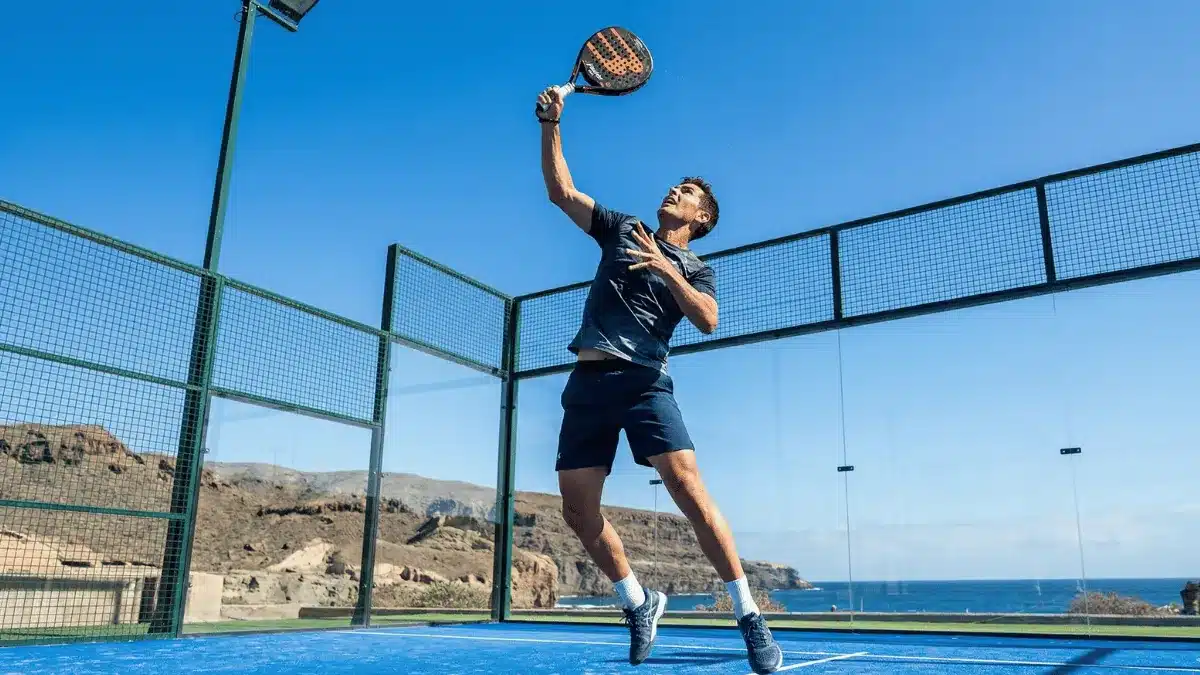
The secret to mastering this technique lies entirely in your early preparation before you even strike the ball. As soon as you realize your opponent is hitting a lob, you must turn your body completely sideways. At the same exact time, raise your racket backward. Unlike a tennis smash where the racket drops down behind your neck, you want to keep the racket head high, open, and facing the sky—exactly as if you were a waiter carrying a tray of drinks. Your non-dominant hand should point directly up at the incoming ball to track its flight path accurately.
2. Footwork and Court Positioning
Never run backward while facing the net. Once you are sideways in the “tray” position, use quick, shuffling side-steps to move back toward the glass wall. You want to position yourself slightly behind the ball so you can step your body weight forward into the shot when you swing. Proper footwork ensures you maintain balance and do not hit the ball while falling backward. You can watch professional players execute this footwork flawlessly on the official Premier Padel tour.
3. The Contact Point and the Slice
Once you are in position, it is time to execute the swing. Because you want the ball to stay low after it hits the glass, you must apply heavy backspin (slice) to the ball. Instead of hitting the ball flat and hard, you want to cut underneath the ball at the moment of contact. Your point of contact should be slightly out in front of your body, around eye-level or slightly higher—never fully extended above your head like a traditional flat smash. As you swing, bring the racket across your body in a high-to-low motion, ensuring the open “tray” face of the racket brushes under the ball.
Common Mistakes When Learning How to Hit a Bandeja
Even with the right theory, players often make a few key errors. The most common mistake is hitting the ball too hard. Remember, speed is the enemy of this shot. If you hit it too fast, it will rebound too far off the back wall. Another frequent error is dropping the elbow during preparation, which turns the shot into a standard flat hit instead of a slice. Keep your elbow high and your racket face open.
Master Your Technique in Gran Canaria
Reading about the mechanics is the perfect starting point, but the only way to truly perfect this essential shot is through targeted repetition with professional guidance on the court. If you are struggling with the timing, the footwork, or the slice, our professional coaching staff is here to help you improve.
When you book one of our premium luxury sports holidays, we dedicate extensive on-court time specifically to overhead positioning and tactical court movement. Reach out to our team today to schedule your next trip to Gran Canaria, and start dominating the net like a true professional!