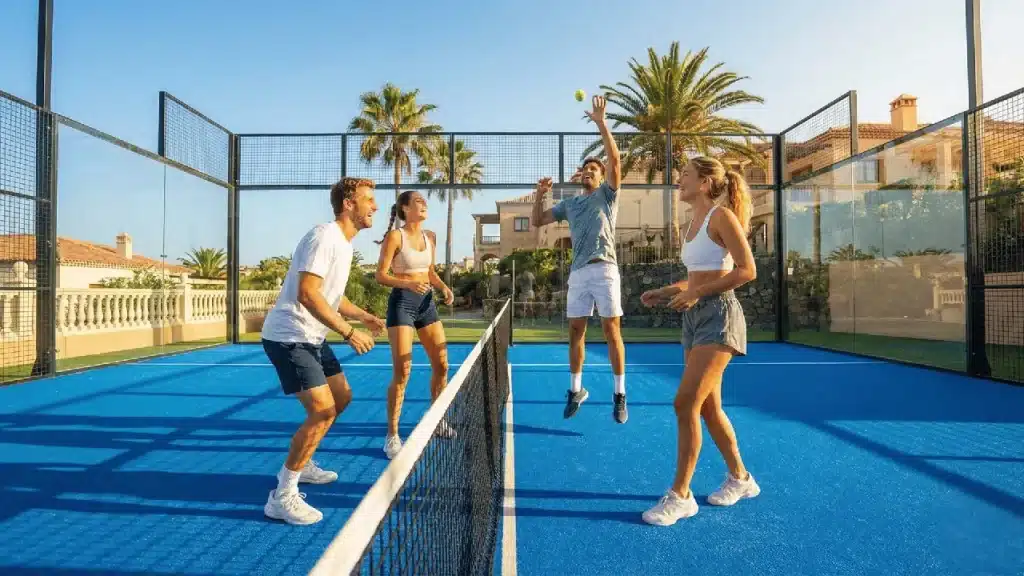
Have you recently discovered the world’s fastest-growing racket sport but find yourself slightly confused by the glass walls and the metallic fencing? You are definitely not alone. Whether you are transitioning from a lifelong background in tennis, or you are stepping onto a court for the very first time, getting the basic padel rules explained clearly is the first step to truly enjoying your matches.
While it looks like a hybrid of several different sports, the actual gameplay is incredibly straightforward once you grasp a few core concepts. You don’t need to read a massive, complicated rulebook to start having fun on your holiday. If you want to jump into a game with complete confidence, here is a simple breakdown of how the game is actually played.
The Basics: Court Positioning and Scoring
First and foremost, the game is almost exclusively played in doubles. You and your partner will face off against two opponents on a court that is roughly one-third the size of a standard tennis court, entirely enclosed by glass walls and mesh fencing.
When it comes to keeping track of who is winning, you can breathe a massive sigh of relief if you already know how to play tennis. The scoring system is practically identical. Points go from 15, to 30, to 40, and then “Game.” Matches are typically played as a best-of-three sets. If a set reaches a 6-6 tie, a standard tiebreaker is played to determine the winner of that set.
The Serve: Keeping It Underhand
One of the biggest adjustments for former tennis players is the serving mechanism. In this sport, there are no aggressive, over-the-head power serves. Every single point begins with an underhand serve.
To execute a legal serve, you must stand behind the baseline, drop the ball onto the turf, and hit it after it bounces. The crucial detail here is that your racket must make contact with the ball at or below your waist level. You must serve diagonally into the opponent’s service box. If the ball clips the net and lands in the correct box, it is called a “let,” and you get to try again without any penalty.
Padel Rules Explained: Playing Off the Glass Walls
This is where the magic happens and where the sport completely separates itself from everything else. The glass walls are not just boundaries to keep the ball from rolling away; they are active parts of the court that you must use to your strategic advantage.
Once the ball travels over the net, it must bounce on the turf exactly once before it hits any of the walls or the fence. If an opponent hits the ball and it smashes directly into your glass wall without bouncing on the ground first, that is an “out” ball, and you automatically win the point.
However, if the ball bounces on the turf and then bounces up and hits the glass, the point is still alive! You can wait for the ball to rebound off the back or side glass and then hit it back over the net.
When Does the Rally End?
Rallies can last a surprisingly long time because the walls keep the ball in play, leading to some incredible, highly athletic rallies. But eventually, a point has to end. You win the rally if:
-
The ball bounces twice on your opponents’ side of the court before they can return it.
-
Your opponent hits the ball directly into the net.
-
Your opponent hits the ball out of bounds (hitting your walls or fencing directly without a turf bounce).
-
Your opponent is physically struck by the ball.
You can read the complete, highly technical regulations on the International Padel Federation website , but these core guidelines are more than enough to get you through your first match.
Ready to Put the Theory into Practice?
Reading about the padel rules explained here is a great start, but experiencing the flow of the game in person is how it all finally clicks into place. If you are visiting Gran Canaria and want to learn the ropes in a fun, relaxed, and sunny environment, our coaching staff is here to help.
Instead of just booking a court and trying to figure it out yourself, join one of our introductory clinics . We will walk you through the scoring, teach you how to read the bounces off the glass, and get you playing a real match in under an hour. Grab your racket and discover why this sport is taking Europe by storm!